Kiki Adventures 0.3.0: seven stages in any order, nine lives and new bosses
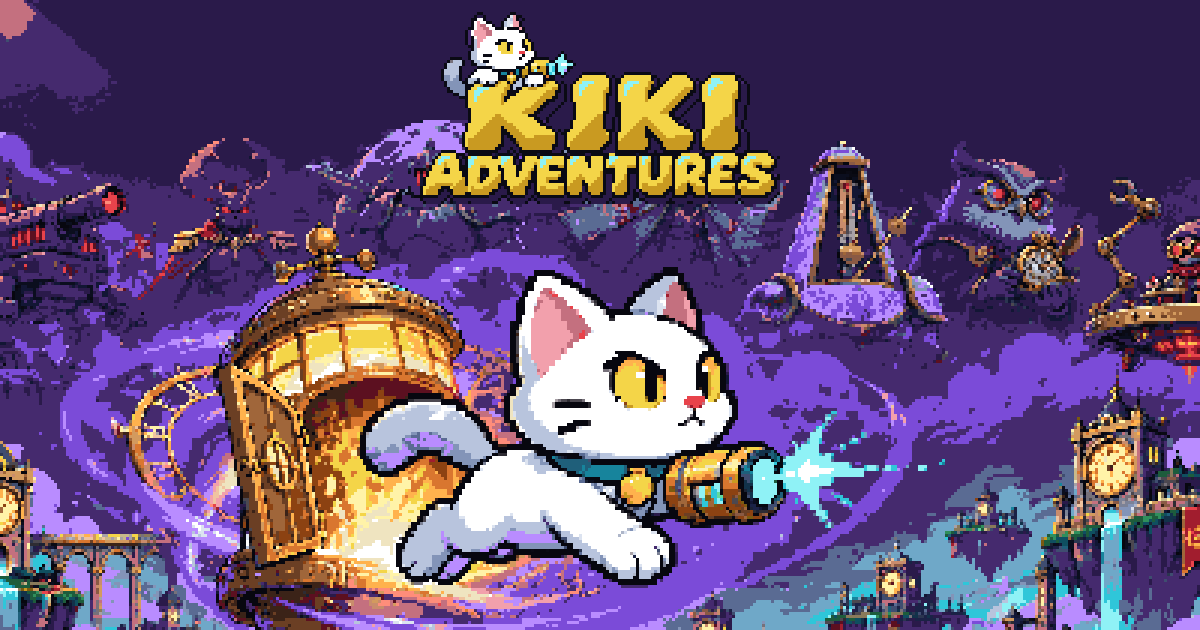
0.3.0 is the version I'm going to start showing people. The biggest change is the shape of the campaign: there is no fixed route any more. The rest of this post is what changed since 0.2.0.
Seven stages in any order
The Driftwreck still comes first and still ends with Bastion. After that the stage select is a three by three grid with Kiki in the middle and a boss portrait on every other square, and all seven of the middle stages open at once. Play them in whatever order you like. When all seven are done, the centre of the grid becomes the Last Hour, the Maker's citadel.
That meant going back over everything that assumed an order. Every stage has to work as the second one you play or the seventh. The weaknesses now form a loop among the seven bosses, so wherever you start there is always a next boss your newest weapon is good against. And the ability gates no longer assume you came from the stage before: every stage has something that opens on the first visit, and the rest is there for when you come back with more.
The middle stages and the final one were redrawn room by room, with new enemies. The first stage got two more checkpoints along the way, at the top of the lift shaft and at the entrance to the concourse. Before, dying in the reactor sent you back to the start of the stage.
Nine lives
Kiki now has nine lives, which is the number a cat is supposed to have. A game over still sends you back to the start of the stage you were on with every life restored, not to the start of the game. A few extra lives are hidden in the stages, and they are rare.
New bosses
Every boss got a new concept, and some of them a new fight.
- The Assembler is a foundry crane that builds soldiers out of scrap and salvaged clockwork.
- Brood-Marshal Varga runs a beetle hive and throws broods of larvae into the fight.
- The Regolith King is a knight of moon rock, and his stage is grey regolith.
- Ossa the Many is a colony of hermit crabs wearing the houses of a drowned town as shells.
- Mother Inkmoth eats the ink of written history and leaves the books blank.
- The Unremembered are erasers in faceless archivist masks, scraping names off history.
- Tock Malvane, the Clockwright, is an old master clockmaker of Meridian who wants to stop every clock so nothing changes again.
- The Maker stands on a floating work platform with four mechanical arms. He wants to finish history the way you finish a machine, with no loose part left.
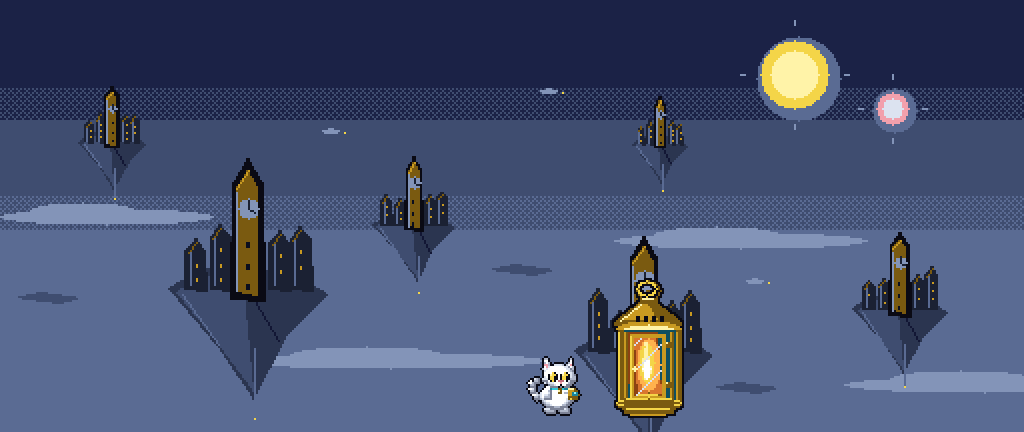
- The Stillwatch is a porcelain and brass sentinel shaped like a sundial, and it only moves on the tick of the great clock in its arena.
Bastion and Assembler Prime stay as they were.
The last fight
The Stillwatch is the last fight in the game, and I rebuilt it from scratch to be a real final boss. It still moves only on the tick of the clock, one leap at a time, and shows where it will land a tick ahead. After each landing its core stays open for part of the wait and then shuts while it winds up for the next leap. Shut, it barely takes any damage.
The fight has three hours, and each one adds something to read. From the first one on, every landing sends a ring along the floor both ways, low enough to jump. In the second, the clock's hands sweep the room: the hour hand runs along the floor and you jump it, the minute hand runs at jump height and you stay under it. In the last one, an echo of it follows one leap behind, repeating the leap it just made, and the time with the core open gets shorter. A good fight runs about two minutes.
The room is now exactly one screen and the camera holds still, so Kiki, the Stillwatch, the mark it will land on and the clock are always in view.
Shellharbor
The coastal town is now called Shellharbor. It is a seaside town the sea took, with the houses still standing half under water, and the tide still comes in on a schedule.
Art, sound and picture
Kiki, the bosses and the scenery of every stage have new art, and bosses now explode when they go down. The soundtrack was redone with more of an SNES sound, and the mix is done by loudness, so one track doesn't come in much louder than the next.
On a 120 Hz or 144 Hz monitor Kiki and the enemies shook against the background. The physics runs in fixed 1/60 s steps, and on those monitors most frames had no step at all: a body stood still for a frame or two and then jumped, while the camera kept gliding. Now what you see on screen is interpolated between the last two physics states. The physics itself didn't change, and the price is at most one step of lag in the picture, 16.7 ms.
On a computer the picture is now scaled by a whole number and whatever is left becomes a border. A window GNOME had maximised to 1797x1011 drew every art pixel 4.68 screen pixels wide, some columns four and some five, and the pixel art came out crooked. You can go back to the old mode in the settings. On phones, tablets and the Switch it still fills the whole screen.
The game's small font used to squash a capital letter to fit its accent, and the accent stuck to it: in Portuguese, Á read as A and CONCLUÍDA as CONCLUıDA. Now the letter keeps its normal size and the accent sits on top, with a blank row in between.
Fairer
Coming back from a checkpoint now gives you a moment. An enemy that comes back near you waits a little before it acts, and an enemy whose spawn point is right on the checkpoint doesn't come back for that life. In some of the rooms before a boss the checkpoint was in an enemy's reach, and every attempt started with a hit. That was fixed stage by stage.
In the Clockwright's stage, the platforms that come and go on the tick now stay on a little longer than they stay off, so you can cross without catching the exact frame of the swap. The workshop door has one soldier instead of two: every attempt at the Clockwright starts there, and the two of them took a third to a half of Kiki's health before the fight began. The extra life hidden in that stage's clock face can now be reached.
Moon gravity no longer sticks to Kiki after she dies, and the blackouts darken the screen again.
Other changes
Boss Rush and New Game+ live in the Extras. Starting a New Game+ cycle now drops you on CONTINUE in the main menu, already showing the cycle number, and quitting in the middle of Boss Rush tells you that run ends there and the next one starts from the first boss.
In the browser and on desktop you can export your progress to a file and import it somewhere else. In the browser that matters: Safari deletes what a site stored after seven days without a visit, and any browser can throw the save away when it runs short of space. The desktop version checks once a day whether a new version is out and says so in a corner of the screen. It never downloads anything by itself.
A PlayStation controller now shows PlayStation buttons, and the controller connected notice says DualSense or Xbox instead of SONY INTERACTIVE ENTERTAINMENT W, which was the manufacturer's name cut off halfway.
If the GPU resets in the middle of the game, because a driver crashed or a laptop switched graphics cards, the window no longer stays white with a broken image icon. If the WebGL context doesn't come back within 8 seconds, the game reloads and you land on the title screen with everything up to the last checkpoint.
Where to play
The game is free. It runs on Windows, Mac, Linux, Android and in the browser, which after the first visit plays even without a connection. On all of them it is in the same 15 languages.
Android is now on the same level as the other platforms. It's a signed APK on the downloads page, for Android 7.0 or newer, with the on-screen controls or a Bluetooth controller. The game fills the whole screen and keeps clear of the camera cutout, the menus scroll by touch and the sliders in the settings work with a finger. In boss rooms where the camera holds still, the on-screen controls move down so they don't cover the arena. Since the game isn't on Google Play, the first time Android asks you to allow installs from the browser.
The homebrew build for the Nintendo Switch is on the downloads page too, as a .nro for consoles with custom firmware. On the Switch it's 11 languages for now, without Arabic, Urdu, Hindi and Bengali.
There is still no account and no ads. The downloaded game, on any platform, sends nothing about you or how you play: the only thing that leaves it is the feedback you choose to send. The website, the blog and the browser version send usage statistics to PostHog, stored in the European Union, with no cookie unless you accept one. If something breaks, the feedback form in the main menu and in the pause menu comes straight to me.
Found a mistake or want to say something about this post? Send a correction or feedback